
Economic Zone

A unique feature of working with STOPECALCTM is the explicit coding of the ore (mena), or economic zone. Nearly every sample line will cover the ore that is to be mined and the dilution that has to be mined to get the ore. STOPECALCTM calculates ore tonnes and grade and full-face tonnes and grade, enabling dilution tracking. Another outcome of the economic zone tracking in STOPECALCTM is that geologists are focused on the ore from the moment of sampling to estimation of mineral resources. The geologist attempts to identify the ore in the face. This may modified upon later graphic review of preceding and succeeding faces in a mine visualization package. A final review and modifications may be made upon receipt of assays.
The economic zone should comprise contiguous coding that includes internal waste and provides continuity from face to face along strike and/or up-dip. Outlier stringers with high assays in the wall rock are normally excluded from the economic zone, per example below. Depending on the resource modeling method, the economic zone can include some external dilution as well to meet minimum mining width requirements. For example, there is not much use to estimate economic zones that are 30cm thick if the minimum mining width is 1m.
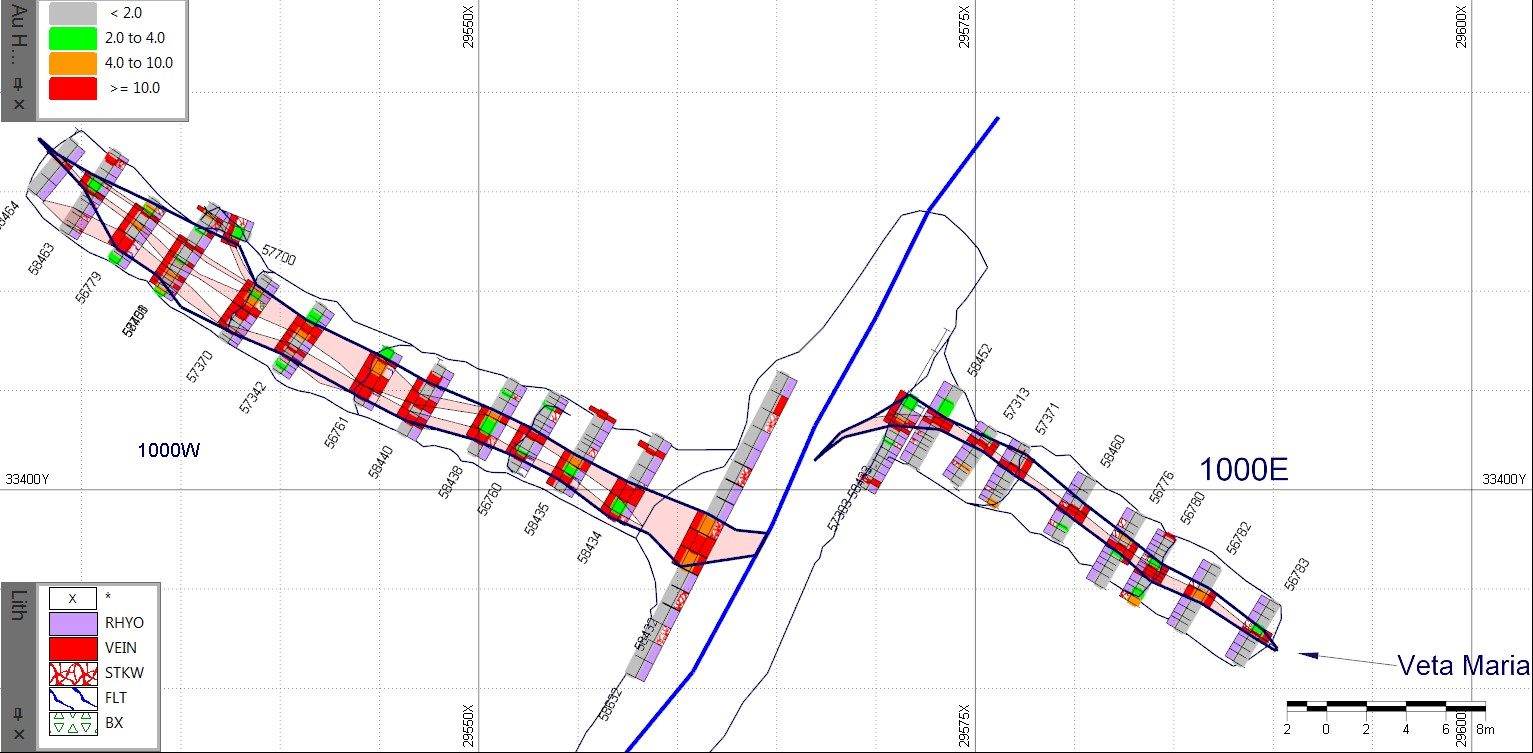
In this example, the geologist has used lithology, assay, minimum width and provision for continuity to denote the economic zone (pink shading). Some outlier high grades are excluded in faces 58434 and 58435 in working 1000W.
The economic zone is explicitly coded in STOPECALCTM to the each sample interval by way of the logical field checkbox, with values of True/False or Yes/No. Users should note that this information may not be available when migrating legacy data because it is seldom coded.