
Round Full Report

Round Full Report Overview
The STOPECALCTM round report is provided for the purpose of reporting and tracking actual ore and waste development as-mined.
The Round Report provides a listing in csv format of all round information for all of the rounds currently selected in the Rounds view. Upon selecting the Create Report option in the Results area, a Windows File Save dialog box opens with options to view or save the report:
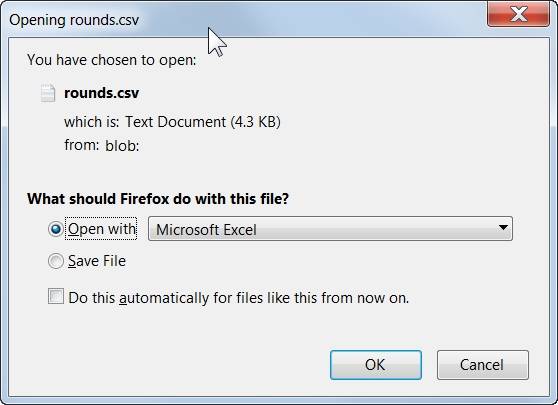
If the user chooses to open with EXCEL, the report opens in EXCEL as single-colume text and must be parsed to columns in a separate step using commas as delimiters. Alternatively, the Save File option can be chosen. The report can then be opened directly and will display with automatic parsing in EXCEL.
The top line is reserved for the field labels. A summary line at the bottom of the listing provides total dimension, tonnage, assay averages and metal content for the rounds in the list by each weighting method:
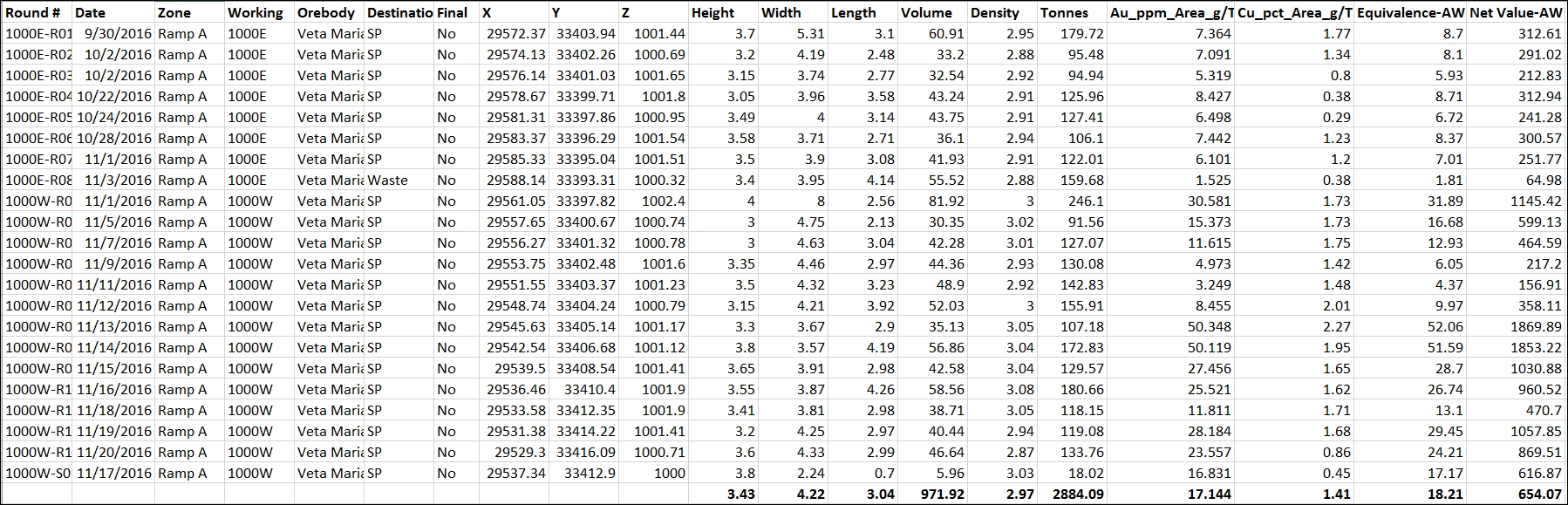
The bold type is added here to illustrate these two lines, between which is the data listing. Dimension units are meters. Grade units are g/T (ppm) for precious metal grade items and percent for other metals. Metal units are listed as troy ounces and metric tonnes, respectively.
Comparing Round to Face Reports
For any group of rounds, the Full Round report will be approximately equal to a Full Face report run with the equivalent faces. In the Lucky Dollar example, applying filters to the Faces to eliminate faces not used in Round calculations, the difference in total length is 0.25%, in tonnes reported, 0.05%, in area-weighted gold-equivalent, 0.2%. All other reported figures are within these ranges, and this should be expected for any project with tight accounting. The main difference in reports is in their purpose: Round reports allow tracking tonnage and grade to the smallest possible production units; face reports are more relevant to stoping where the sampling is done in advance of projection, slices are blasted across many samples, and grade and tonnage units of production are larger, perhaps spanning several shifts.
Another way of comparing the reports is to remember that faces aren't mined in development, rounds are mined. Rounds are blasted and mucked separately and in sequence. Generally they can be surveyed to some extent and tracked. In stoping sampling may be campaigned across the back, and in raises, sampling may take place after the raise is developed, or campaigned several lifts at a time. In these cases, the sample lines ("faces") do not represent production units. Creating "rounds" from these samples is not appropriate and gives no more tracking resolution than running a face report.